You Don't Need to Buy Bottled Drinks
This page was translated from the Japanese original by AI.
Read the original (Japanese) →How often do you buy bottled drinks in your daily life?
Whether it's grabbing a bottle of tea or coffee on a quick trip to the convenience store, or ordering cases of mineral water for home, plastic bottles have quietly become an unquestioned part of our everyday routines.
Recently, however, I completely stopped buying bottled drinks for daily consumption, aside from emergency stockpiles.
I used to go through several bottles a day, but after finally letting go of the habit, my only regret is that I didn't do it much sooner.
In this post, I want to share why I stopped buying bottled drinks and the real benefits I've experienced since quitting.
How I Used to Live: Consuming Plastic Bottles Every Single Day
While I don't buy them at all now, I used to be a heavy user. My spending mainly fell into two patterns.
First were the bottled and canned black coffees bought at convenience stores and vending machines. To keep myself caffeinated during work, I would buy two or three bottles of drinks like BOSS Black almost every day.
Second was buying cases of mineral water for home. I had a recurring order online for 24-packs of 500ml label-less bottles, always keeping a stash in my room. My reasoning was simple: "Taking a bottle with me when I go out is much cheaper than spending 130 to 150 yen at a vending machine." At around 50 yen per bottle, I genuinely thought I was being smart and saving money.
The "Hotel Fridge" Trap and a Monthly Bill Over 10,000 Yen
Reality, however, wasn't so kind.
Thinking, "I have plenty at home anyway, and it's cheaper than buying outside," my discipline slipped. Whenever I felt thirsty—not just when heading out, but around the house as well—I found myself popping open another bottle.
Back then, I also had a bit of an obsession with the idea of a mini-fridge stocked like a luxury hotel. I would line up cold bottles of water in the refrigerator, gulping them down after a hot shower or right after waking up.
The result? A 24-pack would be completely empty in just five to seven days.
Combined with the daily coffee runs, I was casually spending over 10,000 yen every month on drinks alone without batting an eye.
Why I Quit: Little Expenses Adding Up, and Rediscovering Tap Water
The reason I quit came down to one simple realization: "This is a massive waste of money, and I need to cut back."
Fifty yen per bottle might sound cheap, but burning through multiple cases a month turns into a substantial expense. Realizing that over 100,000 yen a year was vanishing into thin air just for basic hydration gave me a serious wake-up call.
Around that time, I stumbled upon a video by Breakthrough Sasaki, an educational YouTuber, which served as a major turning point.
His message was wonderfully straightforward: "Tap water in Japan is safe and drinkable, so using it properly will save you a massive amount of money."
It hit me: "Come to think of it, Japan has some of the highest water quality and safety standards in the world. Why on earth am I spending 10,000 yen a month just to keep buying plastic bottles?"
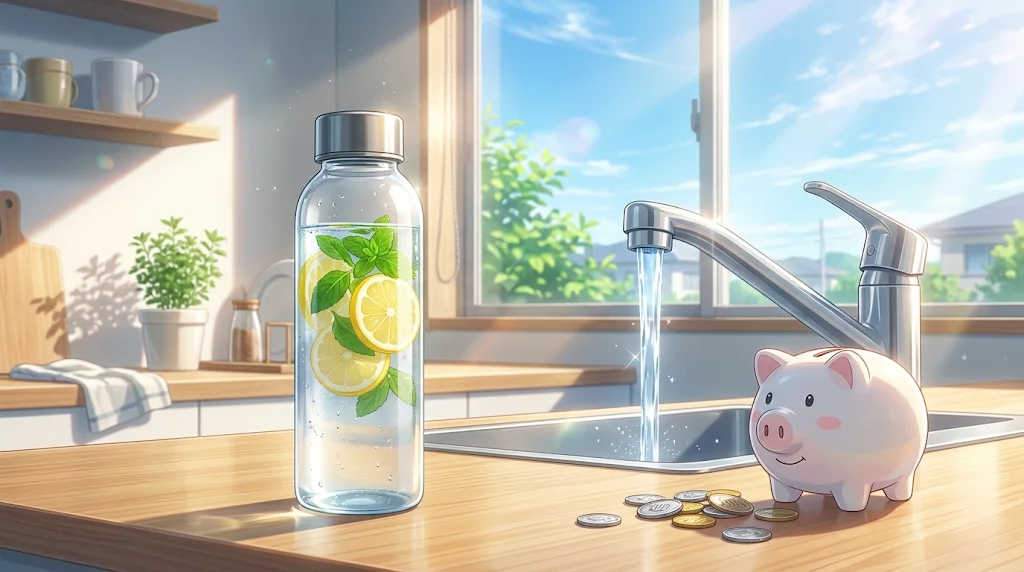
That lightbulb moment prompted immediate action. All I did was purchase a simple, faucet-mounted water filter for around 3,000 to 4,000 yen. With that single, modest investment, my plastic bottle habit came to an effortless end.
Two Major Benefits of Quitting Bottled Drinks
Switching away from bottled drinks brought two major benefits into my life.
1. A Dramatic Reduction in Fixed Expenses (Saving Roughly 120,000 Yen a Year!)
The biggest upside has easily been the drastic drop in monthly spending.
What used to cost over 10,000 yen a month on drinks dropped to virtually zero—aside from a negligible bump in the water bill and the occasional replacement filter cartridge.
- Per month: Saving roughly ¥10,000
- Per year: Saving roughly ¥120,000
Saving 120,000 yen a year is enough to fund a weekend trip, invest in self-improvement, or pick up quality furniture and gadgets. Merely cutting off an expense that was silently draining away in the background provided a huge boost to my disposable income.
As a welcome side benefit, I was also freed from the hassle of receiving heavy cardboard boxes, breaking them down, and peeling labels off dozens of bottles just to crush them for recycling.
2. A Paradigm Shift: "Tap Water Actually Tastes Pretty Good"
Another revelation was realizing that Japanese tap water tastes perfectly fine once passed through a filter.
The faint chlorine smell typical of tap water virtually disappeared after running it through a simple filter costing just a few thousand yen. When chilled, it tastes just as crisp and clean as the bottled water I used to buy.
Letting go of the assumption that "water has to be bought in a bottle to taste good" was a genuine paradigm shift for me.
It gave me a newfound appreciation for the quality of public water infrastructure, and even sparked a curiosity about how water sources and quality differ by region. In a way, it brought a sharper sense of clarity and appreciation to my daily living.
Conclusion: Why Not Start with a Reusable Bottle and Filtered Water?
To be clear, I still keep a supply of bottled water stored away as emergency reserves in case of earthquakes or typhoons. From a disaster preparedness standpoint, keeping stockpiles on hand is essential.
However, when it comes to drinks casually consumed in daily life, there is almost no need to buy plastic bottles.
If you find yourself mindlessly grabbing a bottle of tea or coffee at the convenience store every day, or wondering why your spending on water at home adds up so quickly, give it a shot. Try installing an affordable water filter, or carry your favorite reusable bottle filled with tap water when you head out.
It's kind to your wallet, gentle on the environment, and takes the hassle out of taking out the trash. A far lighter, more comfortable routine is waiting on the other side.
If you enjoyed this, let me know with a like.