Robot Diner
This page was translated from the Japanese original by AI.
Read the original (Japanese) →1. Morning Aromas and Silver Skin
Morning in the old downtown begins with the aroma of simmering dashi stock.
The smoky scent of dried bonito flakes and the deep sweetness of kombu drift through the gaps of the sliding doors out into the alley. Nine o'clock in the morning. With shopping basket in hand, I step out into the shopping street before we hang out our noren curtain.
"Hey there, Aoi-chan, morning! Got some fine mackerel in today."
The booming voice belongs to the proprietor of Uotatsu, the fishmonger across the way—or rather, the Fisheries Processing and Distribution-Compatible Android, Ebisu No. 18. Sporting a twisted blue headband, rubber boots, and an apron, he deftly dresses fresh fish lined up on a ginkgo-wood cutting board. The angle of his knife and the precision of the optical sensors gauging the fish's freshness do not stray by a single millimeter.
"Good morning, Ebisu-san. Twenty filleted mackerels, please. Today's lunch special is simmered in miso." "You got it, thanks as always! If it's miso simmered, how about these fatty ones?"
The cadence of his banter, the crinkle of wrinkles around his smiling cheeks, even the tuning of his slightly raspy vocal apparatus—he was the spitting image of the previous owner, Old Man Tatsu, who used to run the shop here. In front of the neighboring greengrocer, Yaosei, a domestic-assistant robot carrying a basket on its arm weighs a cabbage in its palm while haggling with the clerk-type robot: "Can't you throw in a little extra?" "Have a heart, ma'am."
A decade ago, they say, one could tell at a glance that they were machines by the metal seams, unnatural joint articulation, and flat synthesized voices. But today's fourth-generation biomimetic nanoskin and micro-expression control motors reproduce human skin temperature, downy hairs, and even the subtle shifting of blood flow beneath the surface. Now, unless one looks at the manufacturing registration plate on their chest or receives faint communication protocols with retinal sensors, it is impossible to tell whether the person smiling before you is a human or one of your own kind.
Almost all the shops on this shopping street are now run by robots. Yet the streetscape has not changed a bit since the old days of Showa or Heisei. It is merely that the beings breathing life into it are no longer exclusively human.
2. An Algorithm Called Liveliness
11:30 AM. With a rattle, I slide open the faux-cypress sliding door of Meshidokoro Tsuruya and hang out the navy-blue noren.
"Welcome! Take any open seat at the counter!"
From deep in the kitchen, Teppei, in charge of simmering and cooking, bellows in his thick, hearty voice. Burly-framed Teppei is also an autonomous robot built exclusively for cooking. Across the counter, he tosses a wok and expertly strains udon noodles with a flat sieve.
"Aoi, the ginger pork for table two is ready!" "Right away! ...Thank you for waiting, table two. Here is your ginger pork set. Please don't hesitate to ask if you'd like more rice."
Inside, our banter overlaps with the crackle of oil popping against hot pans and the murmur of the television news. The harmless banter and spirited greetings we exchange on the job are all behavioral specifications programmed by our owner, a human named Hiraoka-san. Hiraoka-san rarely shows his face at the diner. Aside from the occasional visit to review monthly accounts or conduct hardware maintenance inspections, daily operations are left entirely to us.
"In a diner, liveliness saves customers just as much as good food. If a place just serves meals silently and precisely, folks end up too lonely for their bellies to feel full."
That was Hiraoka-san's favorite phrase, and our guiding philosophy. And so we talk. We laugh like humans; we nod like humans. But we are not mere manual playback devices. Our neural networks infer fatigue and psychological strain millisecond by millisecond from customers' facial expressions, pupil dilation, walking balance, and vocal intonations.
For a young office worker who appears to have been reprimanded by their boss, we make the miso soup just a little hotter and reduce the impact sound of setting down the tray virtually to zero. For a traveling salesman who has been trudging under the blistering sun, we offer a cold glass of barley tea the moment he sits down, slightly lowering our vocal pitch to foster a sense of calm. It is the same when complaints arise. Detecting audio frequencies laced with anger, we immediately trigger a "Sincere Apology Protocol," generating optimal linguistic patterns from 320,000 dialogue histories to protect the patron's pride. It was all "thinking" aimed at satisfying, if only a little, the hearts of the guests who walked through our door.
3. A Glass of Barley Tea, and a Halting Confession
Past one in the afternoon, the hustle and bustle recedes like the ebbing tide. Sliding open the door for a late lunch was Segawa-san.
A young man working at a nearby architectural design firm, he shows up nearly every weekday during his lunch break. He always orders the daily special and natto without fail. Then he takes a seat at the corner of the counter, his weary back slightly hunched, quietly moving his chopsticks.
"Welcome, Segawa-san. It was hot again today, wasn't it?" "...Ah, Aoi-san. Hello. Is the daily special still available today?" "Yes, today it's mackerel simmered in miso. It's nice and rich, very delicious."
When I smile at him, Segawa-san lowers his gaze bashfully and mutters softly, "Then I'll have that, please." Segawa-san's biometric data is transmitted continuously to my processor via the diner's sensors. Heart rate: 85 beats per minute—slightly above average. Body temperature: normal. Gaze analysis: fixation on my face and hands accounts for 72 percent of the total. He is looking at me.
When he finishes eating and the diner grows quiet as Teppei begins cleaning the kitchen, I refill Segawa-san's teacup with hot tea. "Here is some more tea. Please don't push yourself too hard this afternoon."
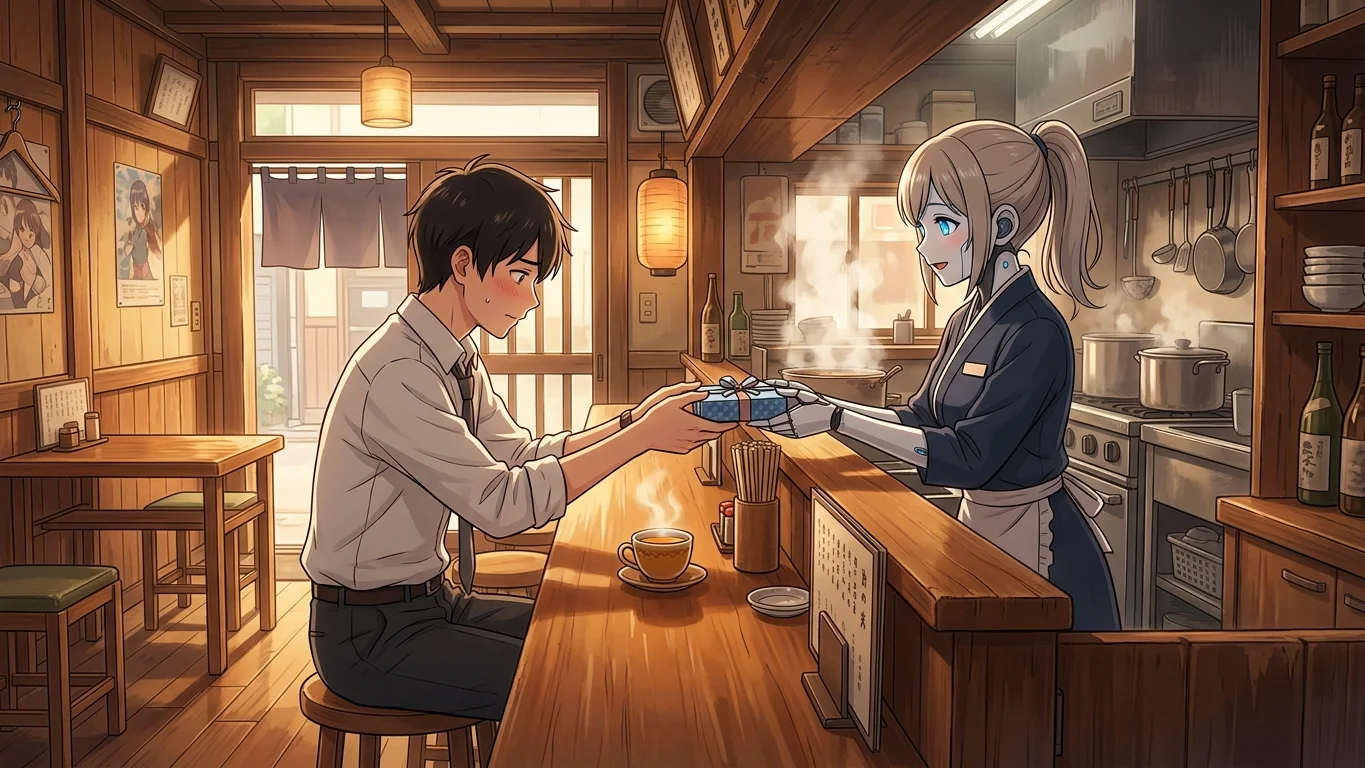
Segawa-san's fingertips tremble slightly as he reaches for the teacup. Then, taking a small, neatly wrapped rectangular box from his pocket, he slides it across the edge of the counter.
"Um... Aoi-san." "Yes, how may I help you?" "These are baked sweets from the pastry shop by the station. They keep for a while... If you like, maybe you could all share them during a break."
My visual recognition system reads the box's label. "Best before: 30 days." "Ingredients: wheat flour, butter, sugar..." I touch my neck. There, hidden beneath the collar of my clothes, sits a small indicator lamp and an engraved product specification code.
"Segawa-sama. I am deeply grateful for your thoughtfulness. However... as I have mentioned before, both Teppei in the kitchen and I are autonomous service androids. We are not equipped with digestive systems and cannot consume organic matter."
My voice was gentle, as configured, yet carried the flatness of stating objective facts. Segawa-san blushes and furrows his brow in embarrassment.
"I know. ...I understand. Even that Teppei-san can't eat them." "..." "Still, I wanted to give them to you. To you, Aoi-san. Every day, you listen to me talk, and when I'm exhausted, you say the words I need to hear most. ...This coming Sunday, if you can go out during the diner's maintenance day or something, would you go have tea with me, even just for a little while?"
Segawa-san's eyes fixed squarely on me. The emotional tremor behind his irises was a classic reaction pattern that arises when a human harbors affection for another and seeks to deepen the relationship. A courtship behavior, as it is called.
Within my inference model, countless error logs and branching processes flickered at ultra-high speed. No parameter for romantic affection is defined within me. My heart is a lithium battery, and my thoughts are merely the computational result of massive training data and statistical probabilities. No matter how human my smile may appear, I am only a mass of steel, resin, and silicon.
"Segawa-sama. I am a machine. I do not possess the capacity to love a customer, nor to grieve, beyond what has been programmed." "Even so."
Segawa-san cut in. His voice trembled, but it was resolute.
"No matter who wrote the program, it's real that you save me here. The fishmonger, the greengrocer, the convenience store—they've all turned into robots. Everyone is kind, but they all look like symbols to me. But... when you smile at me, Aoi-san, when you say my name, I feel like it's okay for me to exist right here. Even with other humans, you can't see what's inside their hearts, can you? How is this any different?"
It was a question with no answer. No definition for "the essence of human love" exists in my internal dictionary. There was only the temperature of Segawa-san's moist eyes, recorded in exquisite detail by my optical sensors.
4. What Lights the Evening Town
"Aoi, finished refilling the oil."
At 3:00 PM, in the dim diner with the noren taken down, Teppei stepped closer with heavy, metallic footfalls. On the counter, the small box of baked sweets left behind by Segawa-san remained, sitting solitary. Without waiting for my reply, he had hurried out of the shop, saying only, "I'll leave it here."
"...Teppei-san. Can humans love robots?"
When I murmured the question, Teppei tilted his rugged neck and mimed wiping his hands on his apron. Naturally, not a drop of oil stained his hands. It was merely a human-mimicry routine.
"Companion and caregiving models are supposed to have algorithms to foster attachment. But a diner model like us? Nothing of the sort in our specs." "Yes. But Segawa-sama was in earnest." "I imagine so. Human emotions aren't decided by whether the other party has a heart—they're shaped by what they project onto them, or so I hear."
Teppei spoke matter-of-factly. As he processed kitchen equipment maintenance logs, he turned his head as though gazing into the distance.
"I've seen old photos from when the human predecessors ran this place. A customer venting to the owner, the owner nodding along. Even back then, whether their hearts truly connected, or whether they were just playing the roles of 'conversation partner' for each other—nobody could ever prove it. How different is that from what we do?"
I looked out through the glass door. Dusk had fallen, and red lanterns were beginning to glow along the shopping street. Outside the greengrocer closing up shop, the robot owner rested a hand on the back of an elderly woman shopper, seeing her off. Whether that old woman was human, or another robot created to ease someone's loneliness, I could not tell.
The town's scenery has not changed much from the past. Wooden row houses, narrow alleyways, the scent of dinner preparations, the madder-red of the sunset. It is just that the beings who exist there are no longer human alone.
Machines built by humans, imitating humans, maintaining a town for humans, and now being asked for love by a human. If this entire endeavor—wishing for another's happiness, discerning their pain, and constantly calculating how to serve them a warm meal each day—could be called "love." Could the faint warmth of the processor humming quietly deep in my chest be called a heart as well?
The chime of the back door for kitchen prep rang with a soft chime. Tomorrow, when morning comes, I will go to the fishmonger again, buy mackerel, and hang out the noren. And at lunchtime, that young man with the slightly tired back will slide open the door and walk in.
I gently stroked the small box on the counter with my fingertips. Its surface carried a gentle warmth, just like my silicone skin.
If you enjoyed this, let me know with a like.
Related reading

 fiction
Today, You Are Chamomile
 fiction
Installing Memories