The Night Before the Engines Fall Silent
This page was translated from the Japanese original by AI.
Read the original (Japanese) →When I twisted the key, a low growl shook the floor of the garage, vibrating straight into the pit of my stomach. Following the metallic whirl of the starter motor, all four cylinders spat fire in succession. Through the palms gripping the steering wheel came a faint, steady tremor—an awkward, yet unmistakably warm pulse of iron and oil.
"...It really is a lovely sound, isn't it?"
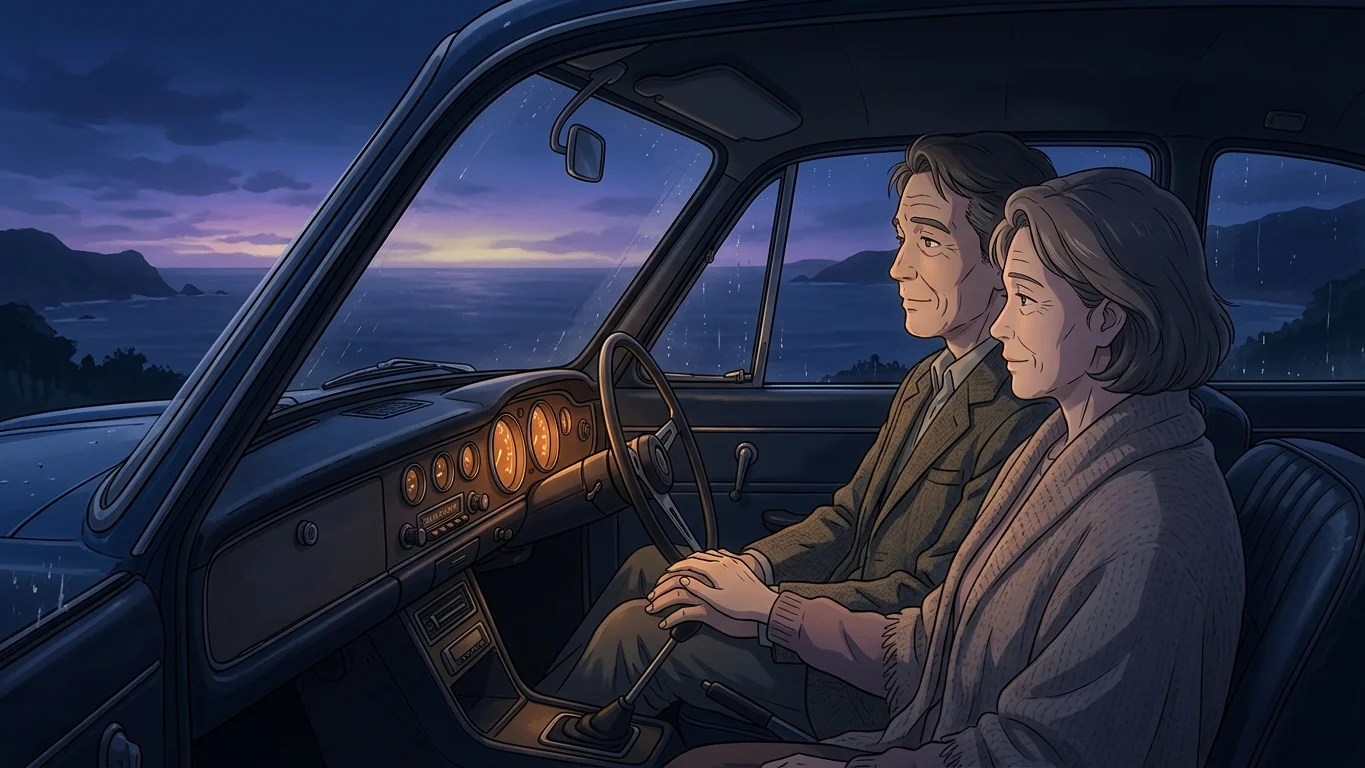
The passenger door shut with a heavy thud, and my wife pulled her seatbelt across her chest. Now fifty, fine crow's feet formed at the corners of her eyes whenever she smiled. Illuminating her calm profile was not the futuristic glow of an in-cabin hologram, but the aged, amber light of the analog instrument panel.
"Let's get going before we bother the neighbors."
I depressed the clutch pedal with my left foot and slotted the shifter into first. A crisp, tactile click of metal engaging metal. A light tap on the accelerator, easing the clutch out to send torque through to the wheels. The chassis dipped slightly, and we glided out into the quiet suburban night.
The streets were eerily, unbelievably still. Every car we passed was a sleek, aerodynamic autonomous pod. Running on electricity harvested from solar panels and home storage batteries, they could glide silently for more than a thousand kilometers on a single charge. Aside from the faint whisper of rolling tires, they left not a trace of noise in the night air.
The gas stations that once dotted every street corner had long since transformed into drone delivery hubs or automated cafes. Even procuring gasoline had become an indulgence—a peculiar, costly hobby requiring advance paperwork and exorbitant fuel taxes.
Nowadays, when people talked about "going for a drive," they meant boarding an autonomous sky-mobility pod—an airborne cabin that cruised along certified corridors hundreds of meters up, looking down on the city lights in passive relaxation. To travel on the ground, pedaling and steering with one's own hands, was viewed as nothing more than a hazardous relic of a bygone age.
"You're still driving that dangerous thing?"
My younger coworkers invariably furrowed their brows whenever the subject came up. Once or twice I had jokingly offered them a ride, but every one of them shook their heads in dead earnest. In a world where vehicles synchronized via millimeter-wave radar and quantum communications, driving the statistical likelihood of an accident to near zero, no sane person wanted to stake their life on the reflexes and judgment of an individual human being.
My wife, however, was different. From the time we first met in our twenties, whether heading out on long journeys or making a quick run to the supermarket, she had always taken this passenger seat as if it were the most natural place in the world.
The expressway toll gate drew near. As we passed under the overhead sign glowing red with "Manual Vehicles / Unsynchronized Lane," the onboard unit let out a sterile electronic beep. While autonomous cars paid mere pocket change thanks to government subsidies, manual cars were saddled with a heavy surcharge for accident liability insurance. The amount deducted from my account was an entire order of magnitude higher.
"It's gotten so expensive," she said with a quiet laugh. "Call it a luxury tax."
Onto the on-ramp. As I stepped down on the accelerator, the white needle of the tachometer leaped upward. Pressed firmly back into my seat, the inline-four engine let out a joyful roar. Wind rush, road noise, and the rhythmic, contained explosions of the machinery—all of it blended together, washing over my ears in a single wave.
The news of the bill passed in parliament yesterday crossed my mind. —A complete ban on internal combustion engine vehicles on public roads, alongside an outright prohibition of manual driving on all surface streets and expressways. Barring narrow exceptions—such as historical vehicles kept in running condition or track use on closed circuits—the right of an ordinary citizen to drive a car with their own hands on a public road would vanish entirely come next spring.
By tomorrow, I would have to start moving forward with either scrapping the car or donating it to a museum. Tonight was, in practice, the very last night I could cut through the dark wind in this car, alongside my wife, without a care in the world.
"Hey," she murmured softly from the passenger seat. "Do you remember? Twenty-five years ago, right after we got married. We almost ran out of gas on that mountain pass in Nagano. We were both sweating bullets."
"I remember. I was terrified. We trusted the navigation too much, and the only station up in the hills was closed for the day." "On that pitch-black pass, you kept telling me, 'It'll be fine, it'll be fine,' slipping the car into neutral and coasting down the slopes... and then the engine finally gave out the very second we rolled into the town at the foot of the mountain."
"I must have looked so pathetic." "Not at all. You were so dependable." She narrowed her eyes fondly, watching the city lights stream past outside. "Back then, cars felt like living creatures. They got hungry, they threw fits, they groaned going uphill. Modern cars are wonderfully convenient, of course... but sitting in this car, I can feel that you're in conversation with it, taking care of me every second we move."
She placed her hand gently on the center console beside the shifter. The car's vibration carried through, faintly trembling through our touching fingers.
"The sound of this engine—it's so close to a human heartbeat. Maybe that's why I've always fallen asleep so easily in this seat." "You sure did. Even in dead-stop traffic on the Shuto Expressway, you'd be snoring away." "I was not! I never snored."
Our laughter melted into the low rumble of the exhaust filling the cabin.
We pulled out into the right lane to pass a convoy of autonomous cars, each vehicle gliding in immaculate formation with millimeter precision. Through their tinted glass, I caught glimpses of passengers with their seats swiveled inward, gazing at floating displays or resting with their eyes shut. Flawless safety, flawless comfort. The utopia humanity had dreamed of for generations, finally realized.
I had no desire to deny its worth. Starting tomorrow, I too would live as a citizen of that clean, sterile, safe world.
And yet, imperfect human beings breathing life into a heap of steel, gripping the wheel of their own volition and pressing into the unknown dark—we knew that primal joy. We had lived it. Guiding a machine with every nerve in our hands and feet, reading the contours of the pavement, carrying someone we loved to their destination amidst the quiet tension of inherent risk. That responsibility, that pride—that was what "driving" had always meant to me.
Leaving the expressway behind, I steered the car up toward a seaside lookout. Not a tourist was in sight. There was only the black horizon and the sweep of a cold night breeze.
I pulled into a parking space between the white lines and turned the key to the left. With a sudden drop, like a heart ceasing to beat, the engine fell silent.
The silence that settled over us was profound and heavy. From deep beneath the hood, the faint, irregular tink, tink of the hot exhaust manifold cooling down was the only sound. It was like a long sigh of relief from a machine that had finally completed a great journey.
"...Thank you for everything," she whispered, gently stroking the dashboard.
Beyond the windshield, the far edge of the horizon was just beginning to shift from deep indigo to pale violet. A new morning was arriving. A new era, filled with perfect silence and harmony, was about to begin.
"That was a good drive," I said.
She smiled softly and nodded. "Yes, it really was. The best drive of all."
In the cooling cabin, we leaned close together, watching the sky slowly brighten. Deep within my ears, the irreplaceable heartbeat of the engine was still humming, warm and clear.
If you enjoyed this, let me know with a like.
Related reading
 fiction
Robot Diner
 fiction
Today, You Are Chamomile
 fiction
Installing Memories