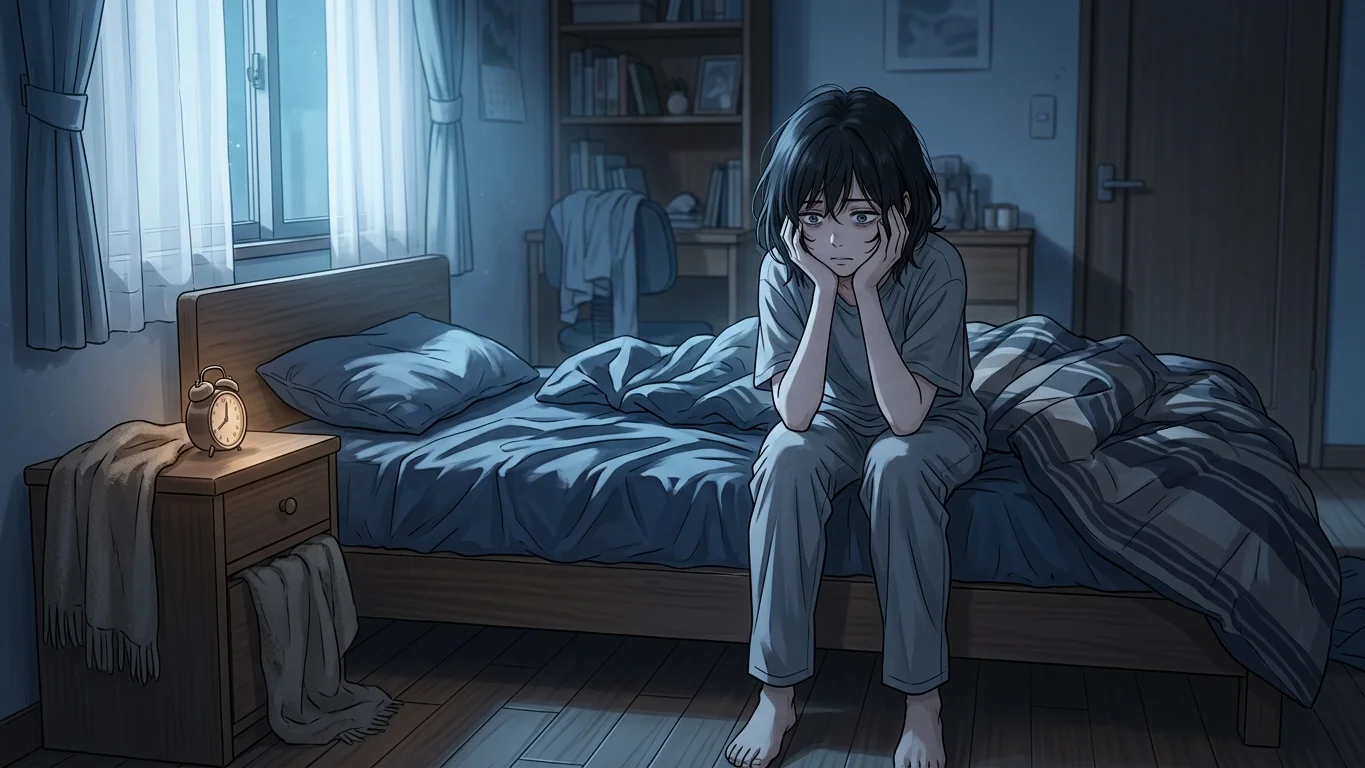
Why Sleep Becomes Shallow Under High Stress
This page was translated from the Japanese original by AI.
Read the original (Japanese) →"The night before an important exam, anxiety and pressure kept waking me up over and over again."
"Something awful happened at school, work, or my part-time job, and even after getting into bed, it felt like I couldn't get a sound night's sleep."
Whether you are a high schooler, a college student, or a working adult, chances are you have experienced this at least once.
What exactly is happening inside our bodies and brains on nights when we feel intense stress or emotional shock?
Recently, an intensely stressful event happened to me out of nowhere. That night, when I checked the sleep data on the smartwatch (Google Fitbit) I wear daily to track my health, I noticed something fascinating.
Using that real-world data as a clue, this article unpacks the mechanism behind why high stress causes shallow sleep and mid-night awakenings, explaining the brain science and hormonal dynamics in a way that is easy to understand for high school and university students alike.
I will also share five recovery habits you can start today to quiet brain arousal and reclaim high-quality sleep.
The "Anomaly" Shown by Fitbit Data: Deep Sleep Remained Intact, but REM Sleep Vanished?
First, let's look at the actual data reflecting the changes in my body.
Normally, I sleep soundly for about eight hours every night.
However, looking at the data from the night that intense stress hit, here is what showed up:
- Total Sleep Time: Plunged from my usual 8 hours to 6 hours and 40 minutes (−1 hour and 20 minutes)
- Non-REM Sleep (Deep Sleep): Maintained just as firmly as usual (about 1 hour and 20 minutes)
- REM Sleep (Light Sleep): About 45 minutes shorter than usual (a substantial drop)
The curious point to notice here is that while I got my usual amount of deep sleep (non-REM sleep) that should make me feel well-rested, only lighter sleep (REM sleep) was shaved off, leading to an overall shorter night of sleep.
It wasn't that I had trouble falling asleep and tossed and turned all night; rather, the lighter sleep that normally arrives in the second half of the night vanished, forcibly waking me up early in the morning.
What on earth was going on inside my brain and body?
What Is Happening Inside the Brain? The Mechanics of High Stress and Sleep
Ever since ancient hunter-gatherer times, the human brain has maintained a defense system to protect us from mortal danger.
When exposed to severe stress, a domino effect unfolds inside the brain.
To make this intuitive to visualize, I'll explain the brain regions and hormones using relatable "roles."
Step 1: The Prefrontal Cortex (The Calm Command Center) Runs Out of Battery
Located just behind your forehead, the prefrontal cortex is the command center of the brain responsible for studying, multitasking, logical thinking, and emotional regulation.
Normally, the prefrontal cortex uses a braking chemical called GABA to keep emotional outbursts in check.
However, when intense stress, fatigue, and a flood of thoughts pile up, this command center runs out of battery, and the GABA brakes fail to engage properly.
Step 2: The Amygdala (The Fire Alarm) Runs Wild: "A Bear Has Appeared!"
With the brakes off, the danger sensor deep in the brain—the amygdala—goes into overdrive.
The amygdala is, in essence, the brain's "fire alarm."
Even when responding to modern interpersonal drama or test pressure, the amygdala mistakenly assumes, "A giant bear has appeared right in front of us!" or "We're surrounded by venomous wasps!" and blares an emergency siren continuously.
As a result, the body instantly enters fight-or-flight mode (the sympathetic nervous system at maximum throttle).
Step 3: Noradrenaline vs. Adenosine Tug-of-War (Why REM Sleep Gets Slashed)
When the fire alarm sounds, the brain secretes an excitatory chemical called noradrenaline (norepinephrine).
This is the very substance that makes your heart pound and snaps your eyes wide open the instant you spot a bear or a cockroach.
Under normal circumstances, humans cannot sleep in a combative state fueled by noradrenaline.
Yet, when night falls, we manage to fall asleep initially. Why is that?
The reason lies in a sleepiness-inducing chemical called adenosine.
Adenosine acts like an "hourglass of sleepiness" that accumulates in the brain the more you use your mind and body during the day. By nighttime, the hourglass fills up, prompting a forced shutdown—"No matter how much noradrenaline (combat chemical) is pumping, we've hit our limit!"—and plunging the body into deep sleep (non-REM sleep) during the first half of the night.
The problem, however, arises in the second half of sleep.
While you sleep, adenosine in the brain gets cleared out and steadily diminishes.
Once past midnight, the force of adenosine (sleepiness) wanes, and the remaining noradrenaline (alertness) in the system takes the upper hand.
Consequently, the REM sleep that should predominantly appear during the latter half of the night is blocked, leading to mid-sleep awakenings. This is the true culprit behind why my REM sleep plummeted by 45 minutes.
Step 4: Cortisol (The Morning Alarm Clock) Fires Too Early
There is another culprit responsible for shortening overall sleep: the stress hormone cortisol.
Secreted by the adrenal glands sitting above the kidneys, cortisol serves as a "natural alarm clock" that normally peaks around 6:00 AM to wake the body up naturally.
However, when the fire alarm keeps ringing due to high stress, excess cortisol is churned out during the night.
An alarm clock that is supposed to reach 100% at 6:00 AM hits 100% at 3:00 or 4:00 AM.
When this happens, the body mistakenly concludes, "It's already morning! Time to get up and fight the bear!" and snaps wide awake well before it's actually time to get up (early morning awakening).
Step 5: Completing the Vicious Cycle the Next Morning
Having had total sleep time and REM sleep curtailed this way, the brain's command center—the prefrontal cortex—has not recovered sufficiently by the next morning.
As a result, focus and judgment deteriorate further the following day, stress tolerance drops, and the amygdala sounds alarms at the slightest provocation... leading right into a vicious cycle of stress and sleeplessness.
Stop the Brain's Rampage! 5 Recovery Habits You Can Start Today
"I understand the mechanism, but stress is sometimes unavoidable..."
You might be thinking that.
Here are five habits to restore your brain's braking power and protect your sleep, which I am personally putting into practice. None require special equipment or money, and anyone—students included—can try them starting today.
1. Morning Cold Showers (Strength Training for the Autonomic Nervous System)
When you wake up, finish your usual shower with a few dozen seconds of cold water.
A blast of cold water spikes your heart rate and momentarily ramps up the sympathetic nervous system (tension/alertness), but immediately afterward, the body scrambles to activate the parasympathetic nervous system (relaxation) to bring you back to a calm state.
By conditioning the body with the experience of "quickly returning elevated tension to baseline calm," you train the autonomic nervous system's braking power, allowing you to regain composure swiftly even when hit with heavy stress during the day.
2. Deep Breathing Habits (Strengthening the Prefrontal Brakes)
People often say, "Take a deep breath when you're frustrated or anxious," and there is clear neuroscience backing this up.
Slow, deep exhalations have been shown to boost the efficiency with which the prefrontal cortex delivers braking signals (GABA) to the amygdala.
Even when your head is tired and your command center is on the verge of shutting down, slipping in deep breaths reassures the fire alarm: "It's okay, there's no danger." Try incorporating deep breathing—inhaling for 4 seconds and exhaling slowly for 8 seconds—between study sessions or before bed.
3. Daytime NSDR (Fast-Charging the Brain's Battery)
NSDR (Non-Sleep Deep Rest) is a recovery practice championed by neuroscientists like Professor Andrew Huberman of Stanford University, designed to give the brain deep rest without sleeping.
A great time to do this is for 20 minutes between 12:30 PM and 3:00 PM, when the day's fatigue starts setting in.
Lie down or sit back comfortably in a chair, search for "NSDR" or "Yoga Nidra" on YouTube, and follow the guided audio as you move your awareness through different parts of your body to release tension.
Doing this for just 20 minutes resets prefrontal cortex fatigue and preemptively prevents the amygdala from going rogue at night. A major advantage over napping is that it doesn't leave you feeling groggy afterward.
4. Task "Decoupling" Habits
Do you ever climb into bed only to start stewing: "What should I do about that tomorrow?" or "Will I finish that assignment?"
When unfinished tasks linger in your head, the prefrontal cortex assumes, "We're still on the clock!" and refuses to relax.
This is where task decoupling comes in.
At the end of your day (at your desk before bed), physically bring your work to a close by writing down on paper or in a planner: "Work ends here today. The rest of this and that will be done tomorrow at [time]."
By writing down that you've handed things off to tomorrow's self, you give the prefrontal cortex explicit permission: "Today's work is done; you can rest now."
5. Daytime Aerobic Exercise (Filling the Sleep Hourglass)
Lastly, the simplest yet most potent habit: daytime physical activity.
Moving your body during the day—brisk walking during your commute, light jogging, taking the stairs—builds up plenty of adenosine (the sleepiness molecule) in the brain.
By thoroughly filling that "sleepiness hourglass" before nightfall, powerful sleep pressure will overpower any noradrenaline lingering from daytime stress, naturally steering you into deep sleep.
In Conclusion: Trouble Sleeping Doesn't Mean You Are Mentally Weak
When you're wide awake or jolting awake in the middle of the night after an intensely stressful day, it's easy to blame yourself:
"My mental game is so weak..."
"I have an early morning tomorrow—why can't I just fall asleep?"
Please don't be hard on yourself.
It isn't because you lack mental strength; it is proof that your brain and body are desperately maintaining a high-alert stance to protect you from danger (the bear).
Knowing this brain mechanism allows you to observe yourself objectively: "Ah, my amygdala mistakenly thinks a bear is here and is sounding the alarm," or "Adenosine and noradrenaline are having a tug-of-war right now."
Why not start tonight with a few slow, deep breaths?
I hope your brain and body can regain the peaceful rest they deserve.
If you enjoyed this, let me know with a like.